In 1996, a father brought his two sons to the Utah Beach sign and took their photograph. Thirty years later, one of those boys came back with his own son and stood in exactly the same place, because in 1944, their grandfather came ashore on this beach.
Two photographs, thirty years apart, the same white signpost in the dunes.
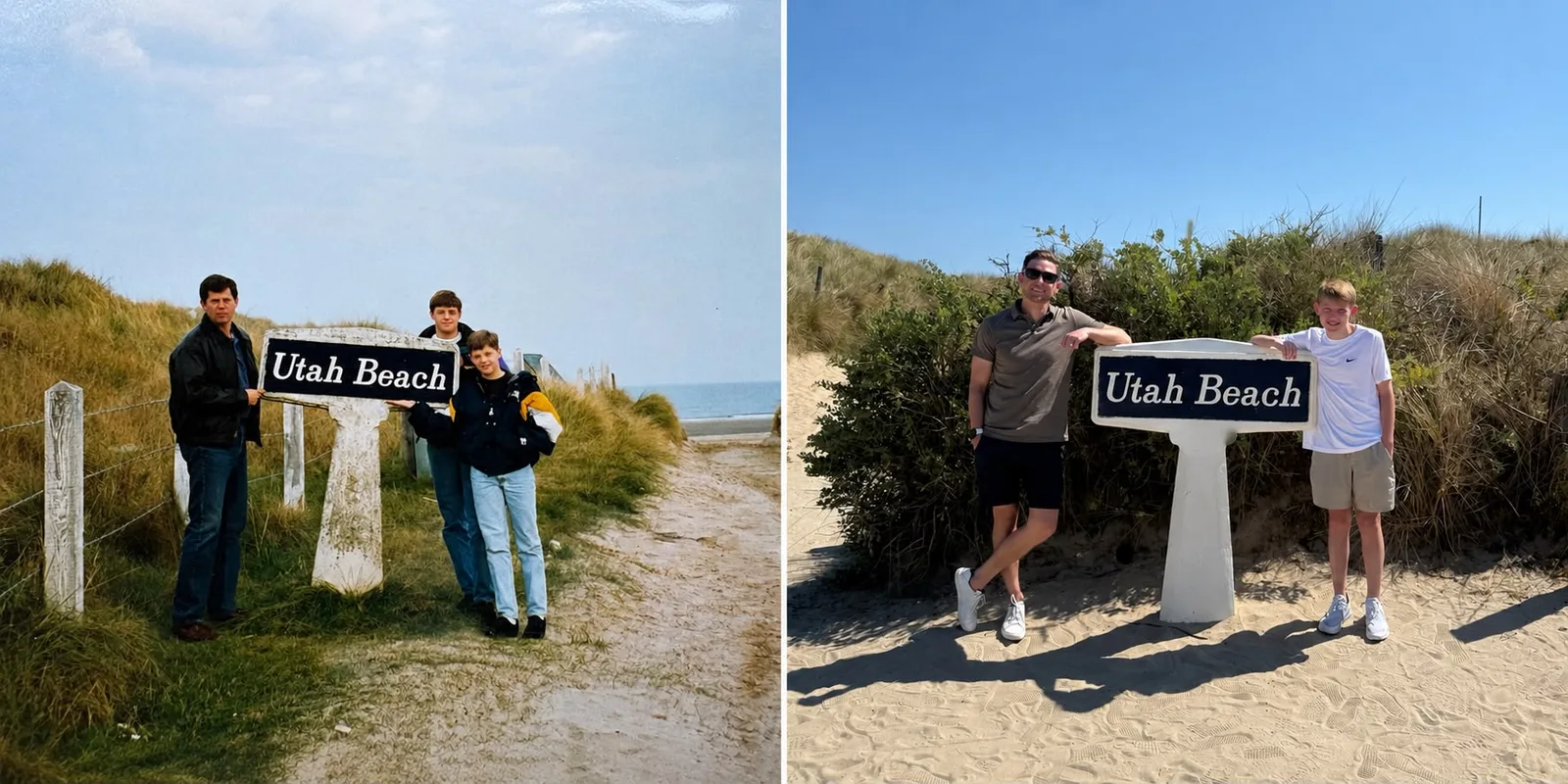 Utah Beach, 1996 and 2026. Left: Kyle’s father with his two boys. Right: Kyle and his son Mason, at the same sign, thirty years later.
On the left, 1996. A man has brought his two sons to Normandy and lined them up against the Utah Beach sign. One of those boys is Kyle Jansen. On the right, this summer. Kyle is the man now, and the teenager beside him is his own son, Mason. Same sign. Same sand. Same sea behind the dune.
They did not stage this to be clever. They came back because the man who first walked this beach was Kyle’s grandfather, and in this family you come back.
I spent that day with them. Some encounters justify an entire career. This one is that kind.
A Boy and a Tootsie Roll
One summer morning on Utah Beach, a fourteen-year-old American kid started talking to me about Tootsie Rolls. Not casually. With the quiet precision of someone who knows exactly why those candies matter.
His name is Mason Jansen. His great-grandfather Norbert came ashore on this beach on September 8, 1944. And that morning, somewhere between words I did not fully catch and sentences he did not fully follow, something essential passed between us anyway.
Mason arrived with his father Kyle, his mother Ashley, and his little sister Brinley, twelve years old. Not a single cell phone in sight all day. No screens, no earbuds, no thumbs scrolling while the guide talks. Just kids who looked, listened, and asked questions. Parents who had clearly decided that some experiences are not meant to be lived through a screen. That alone moved me before Mason even opened his mouth.
The family is from the Chicago area. And if you have never guided a group of Chicago teenagers who talk fast, very fast, with that Midwest accent that rolls and swallows the ends of sentences, good luck to you. I did my best. They did theirs. We met somewhere between my French accent and their machine-gun delivery, and somehow it worked just fine.
What a GI Carried in His Pockets
Mason is the one who brought it up. He talked about Tootsie Rolls with the easy confidence of someone who has always known.
That chocolate candy was invented in 1896 by Leo Hirshfield, who named it after the nickname of his daughter Clara, Tootsie. It went into American field rations because it did something almost no other candy could do: it held up. Heat, cold, rough handling, months in a crate, the thing simply refused to be ruined. American troops had been carrying it since the First World War for that reason alone. It delivered a fast hit of sugar to a man who needed one, and it survived just about anything. The military knew what it was doing. And Mason, at fourteen, knew all of this. He knew why.
But Tootsie Rolls were not the only things packed into the kit bags of the GIs who came ashore in Normandy. They carried Wrigley’s gum. They carried Hershey’s chocolate, reformulated so it would not melt in the heat, at the expense of taste, truth be told, because the army wanted a ration bar a soldier would eat when he was hungry and not before. They carried Camel cigarettes, and K and C rations in their careful wrapping. Some of them carried escape maps printed on silk or rayon rather than paper, impossible to tear, and silent to unfold in the dark.
Everyday American objects, dropped onto the Norman coast. A whole country, packed into canvas bags and tin cans.
September 8, 1944
Here is a detail worth pausing on. Norbert Jansen, an engineer in the U.S. Army, set foot on this sand on September 8, 1944, three months after D-Day. The family long believed the date was June 8. The records say September.
That correction matters more than it looks. By September 1944 the fighting had moved far inland, and yet men were still coming ashore at Utah, because the great deep-water port at Cherbourg had been so thoroughly wrecked by the Germans before its capture that it could not take the load. So the beach kept working. Long after the drama of the landings was over, long after the newsreels had moved on, Utah went on swallowing men and matériel across the open sand.
Norbert was one of them. Not a June 6 assault wave, not a photograph in a history book. An engineer, walking up a working beach in September, doing the unglamorous work that kept an army fed and fighting. That is its own kind of story, and I would argue it is a truer one.
The Chain, Generation to Generation
Decades later, Norbert’s son brought his own boys to this same beach. It was 1996. Kyle was close to the age Mason is today. He walked where his grandfather had walked. He looked out at the sea. He listened. And his father took a photograph of him at the signpost.
And now it is Kyle who brings Mason. And Brinley. And Ashley. And the photograph gets taken again.
Four generations. One beach. A memory that does not fade.
What makes this family extraordinary is not just Norbert’s story. It is the decision, made again by each generation, to come back. To make the trip. To stand on this sand and say to their children: look. Listen. Remember.
What This Job Teaches Me About Love
Kyle and Ashley are around my age. And watching them that day, something very personal stirred in me.
I do not have children. I say that without shame, quite the opposite. But if I had, this is exactly how I would have raised them. With love, yes. But not only love. Because love without transmission stays hollow. The love that builds something is the love that explains, that takes you places, that sets intelligent limits. No screens today, kids. We are on a beach in Normandy. You can have your tablet from six to eight tonight. Right now, we are here. We look. We listen.
Brinley, twelve years old, had that look. The one that takes everything in, that records without seeming to. I could feel it. It makes complete sense with parents like hers. She will grow up with this beach somewhere inside her, like a foundation.
This job feeds me with exactly that. The love of others, their stories, the way families build themselves and pass themselves on across generations and oceans. It is not naive idealism. It is a poetry of the real, the kind I meet in the field, every day, if I take the time to look.
”One Day I’ll Bring My Own Kids Here”
That is the sentence that got me.
At some point during the day, Mason turned to his father and said, with the quiet seriousness of a kid who has just made an important decision: “Dad, one day I’ll bring my own kids here.”
He is fourteen. He is already planning the fifth generation on Utah Beach. He does not yet know who his children will be. He already knows he will bring them here.
That is living memory. Not a museum. Not a plaque. A teenage American boy talking to you about Tootsie Rolls on a Normandy beach, who knows what was in his great-grandfather’s pocket, and who decides that morning, looking out at the sea, that the chain will not end with him.
Somewhere around 2050, there will be a third photograph at that signpost. I would like to think the sign will still be standing. I am fairly sure the family will be.
If Your Family Has a Beach Too
That morning on Utah Beach, Mason Jansen taught me something. It is not history that keeps memory alive. It is the families who choose to come back. And the children who choose to keep going.
If your own family has a connection to the Second World War in France, through a soldier, a sailor, an airman or a nurse, contact us. I will help you find their story, walk the ground they walked, and stand you in the exact place where they stood. Bring the old photograph if you have one. We will find the spot. And then you take the new one.
Thank you, Jansen family. For what you gave me that day without knowing it.
À Norbert, arrivé un jour de septembre. Et à Mason, qui reviendra.
Belinda C.
Sources: U.S. Army engineer landing records, September 1944; American Battle Monuments Commission; Utah Beach Landing Museum, Sainte-Marie-du-Mont. Photographs published with the kind permission of the Jansen family.