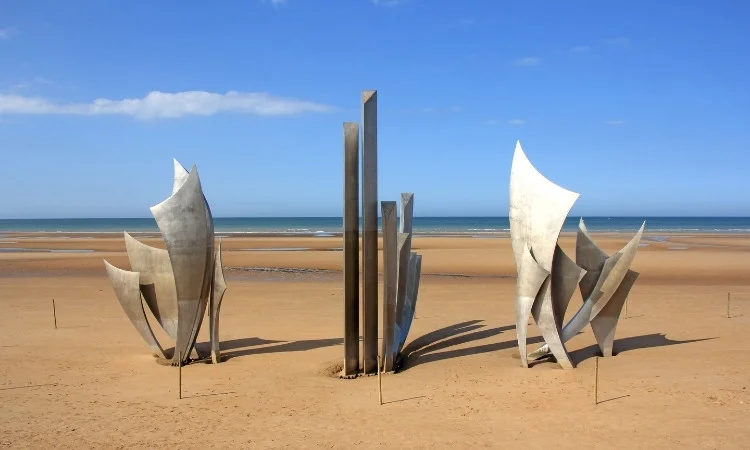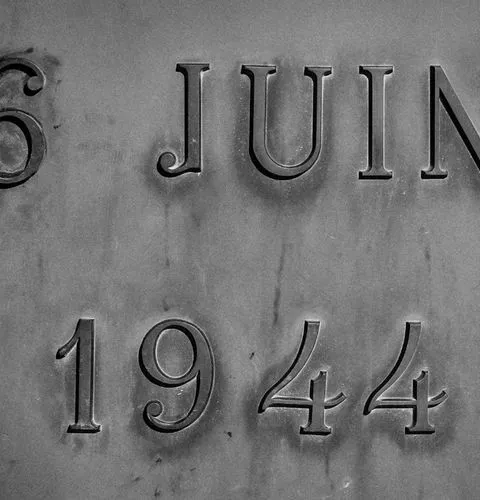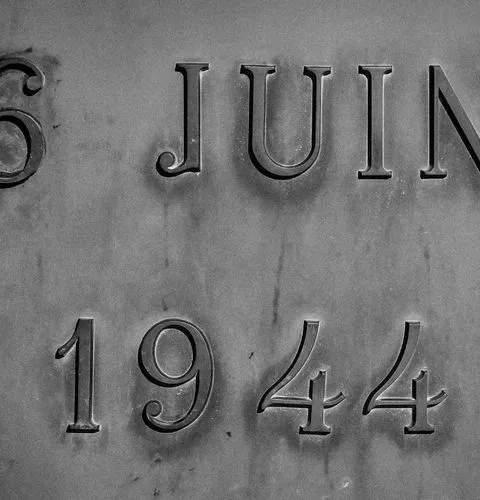


The D-Day landing sites stretch across 80 kilometres of coast, five sectors, a dozen museums and four military cemeteries. Here is what is actually there, what each part costs you in hours, and how to decide whether you need one day, two, or three.
Almost every message I receive about Normandy contains the same sentence: we would like to see the D-Day beaches, we have one day.
I never argue with it, because a well built day on this coast is a real experience and I have watched it move people to tears. But I do ask one question back, and it changes the conversation every time: which part of the D-Day beaches?
Most people have never had to think about it. In their mind, the landing beaches are a place, singular, the way the Lincoln Memorial is a place. In reality they are roughly 80 kilometres of coastline, five separate landing sectors, two inland airborne drop zones, more than a dozen museums, and four large military cemeteries belonging to three different nations. You could spend a week here and still leave things unseen.
So before you book anything, spend twenty minutes deciding what you actually want to stand in front of. This article exists to help you do that. I have guided this coastline for 18 years, and this is the honest accounting of what is there and what it costs you in hours.
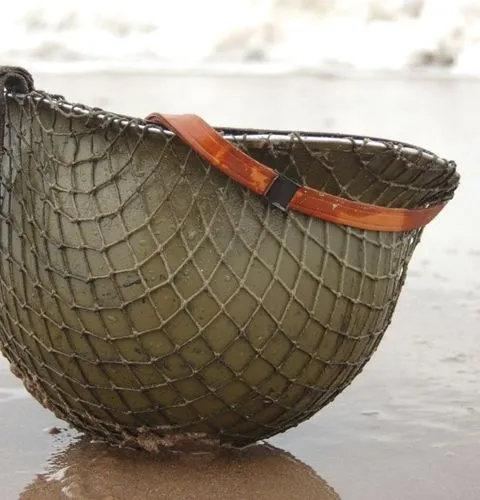 The landing coast runs for roughly 80 kilometres, from the Cotentin peninsula to the mouth of the Orne
The American Sector, and What It Really Costs in Hours
This is the part every American traveller arrives knowing, usually through Saving Private Ryan and Band of Brothers, and it deserves its reputation. Utah and Omaha were the two American landing beaches, and the airborne divisions dropped inland behind them during the night.
Sainte-Mère-Église is where the 82nd and 101st Airborne came down in the dark, and where a parachute still hangs from the church tower in memory of John Steele. The Airborne Museum next to the square is genuinely good. Allow an hour and a half for the town and the museum together, more if you have a paratrooper in the family.
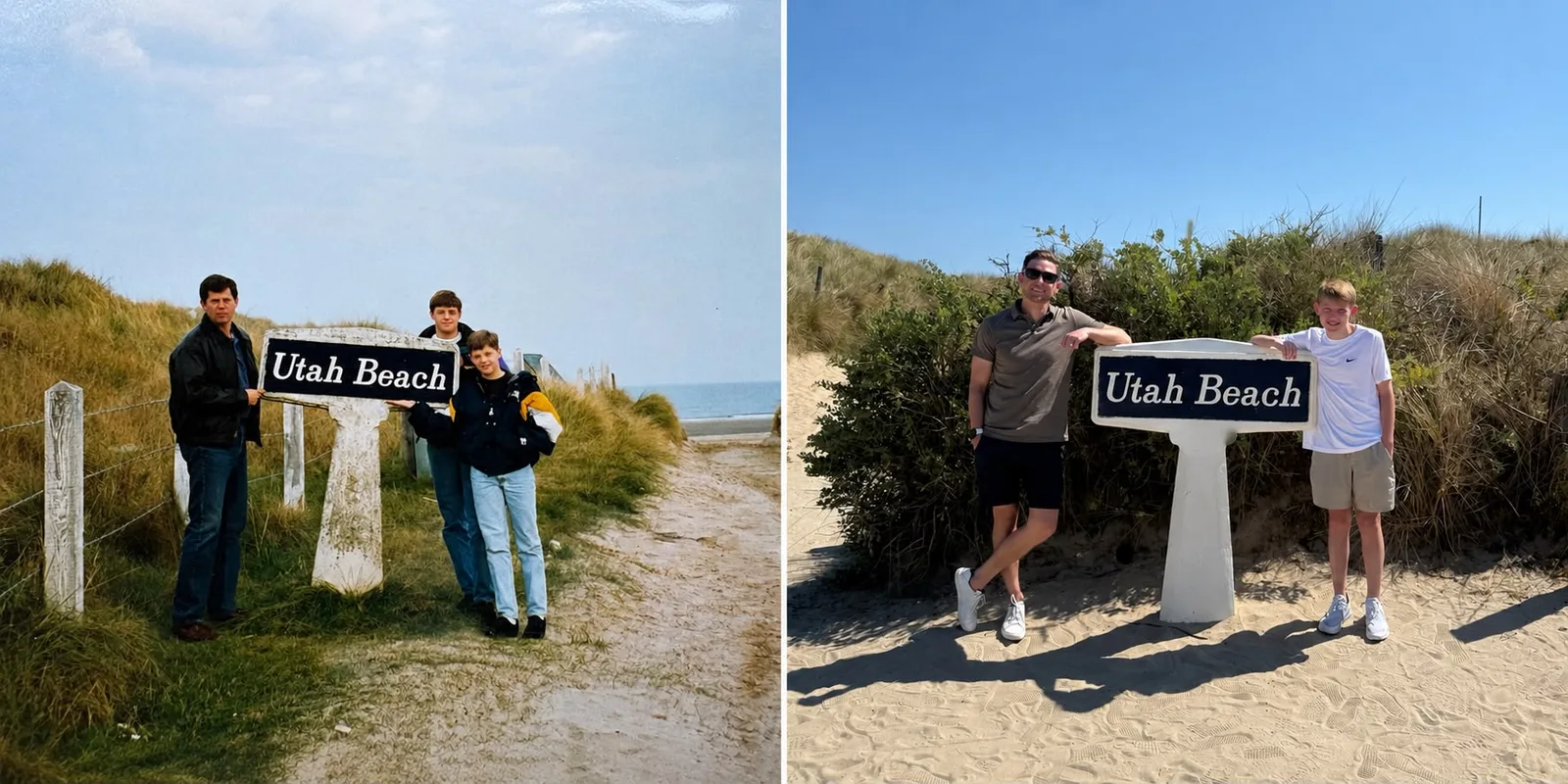
Utah Beach is the quieter of the two American beaches, a wide flat shore where the landing went comparatively well, with a museum built into a former German bunker that holds a B-26 Marauder. Count an hour and a half.
Pointe du Hoc is the site people least expect to affect them. The Rangers scaled a hundred feet of cliff under fire to reach gun emplacements that had been moved inland days before. The ground is still torn open by the naval bombardment, and the bunkers sit exactly where they were left. It takes a good hour to walk properly, and you will want that hour.
Omaha Beach and the Normandy American Cemetery at Colleville-sur-Mer are the emotional centre of the sector, and they are the two things you must never rush. The beach itself, then the visitor centre, then 9,387 white marble crosses and Stars of David above the bluff. Two hours is the minimum. Three is better, especially if you have a name to find.
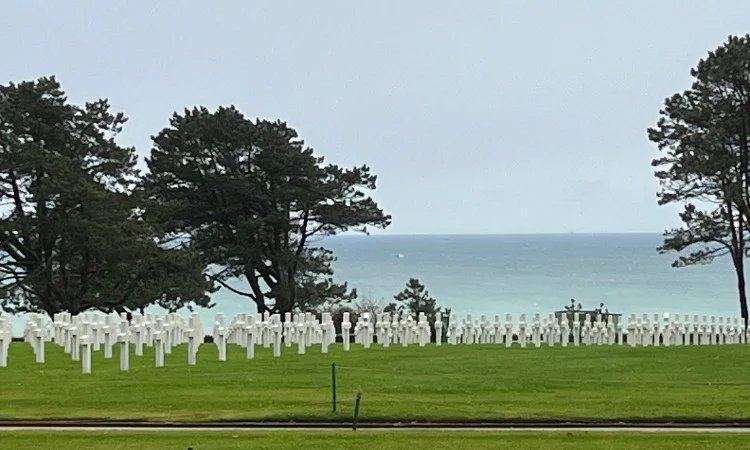 The Normandy American Cemetery at Colleville-sur-Mer, above the bluffs of Omaha Beach
Add the driving time between sites, which is real, and you have already filled a long day without setting foot outside the American sector. That is not a warning. That is simply the arithmetic, and it is why a focused single day on this coast works so well.
The British and Canadian Sector, the Half That Most Visitors Skip
Here is where I want to make a case, because this is the part of the coast Americans most often leave out, and I think it is a genuine loss.
Gold, Juno and Sword lie east of Omaha, towards Caen, and the story there is different in character. Less about assault under fire, more about engineering, improvisation and the moment the invasion turned from a landing into an army.
Arromanches is the reason to go. In the days after 6 June, the Allies towed an entire artificial harbour across the Channel and sank it into position off this village, more than seventy concrete caissons, each the size of a five storey building. At its peak, Port Winston handled 9,000 tons of supplies a day. You can still see the caissons from the beach, sitting out in the bay eighty years later. It is one of the most extraordinary feats of the entire war, and most visitors have never heard of it.
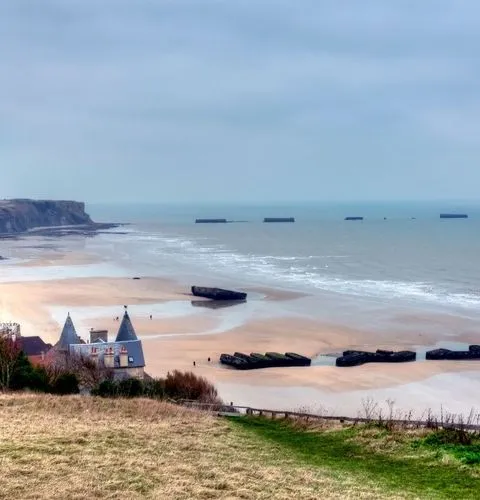 The remains of the Mulberry harbour at Arromanches, still lying in the bay after eighty years
Juno was the Canadian beach, and the Juno Beach Centre at Courseulles-sur-Mer is the only museum on this coast built by Canada to tell Canada’s war. Around 14,000 Canadians landed here on the day and more than 350 were killed before the morning was out. If you have any Canadian connection at all, this is not optional.
Pegasus Bridge, at Bénouville, is where D-Day actually began. Shortly after midnight, six gliders carrying British troops of the Oxfordshire and Buckinghamshire Light Infantry came down in the dark beside the bridges over the Caen canal and the Orne, and took them in ten minutes. The original bridge is preserved at the Mémorial Pegasus alongside a full size glider replica. It is a small site with an outsized story.
Sword Beach, at Ouistreham, closes the eastern flank, with the Grand Bunker museum in a preserved German fire control tower.
Realistically, the British and Canadian sector is half a day if you pick two sites, and a full day if you want to do it justice. It does not compete with the American sector. It completes it.
Museums or the Ground Itself: The Choice Nobody Warns You About
This is the decision that quietly ruins more Normandy days than any other, and almost nobody sees it coming.
The landing coast has an exceptional density of museums, and they are not filler. Several are world class. But every museum you enter is two to four hours you are not spending on the ground where it happened, and the two experiences do fundamentally different things. A museum explains. The ground affects you. Both are worth having. You cannot have all of both in a day.
My rule, after eighteen years of watching people run out of daylight, is simple: one large museum, or two small ones, per day. Not more. Beyond that, the day stops being a visit and becomes a schedule.
The Mémorial de Caen, and Why It Is a Half Day on Its Own
The Mémorial de Caen deserves its own paragraph because it is the one people underestimate most.
It opened in 1988, built directly on top of a German underground command post, and it is not a D-Day museum in the narrow sense. It walks you through the collapse of peace in the 1930s, the occupation, the landings, the Battle of Normandy that followed, and then out into the Cold War. It is a serious institution with the ambition of a national museum, and it is widely considered the best war museum in France.
The official recommendation is a minimum of three hours. In practice, if you read the panels and watch the films the way it is designed to be read and watched, you are there for half a day. I have seen visitors plan ninety minutes for it and leave frustrated in both directions, having neither seen the museum properly nor kept their afternoon.
So here is the honest arbitration. The Mémorial sits in Caen, inland, roughly half an hour from Arromanches and rather further from the American sector. If you have a single day on this coast, going into the Mémorial costs you the American beaches, or it costs you the British sector. That is a real trade and you should make it deliberately rather than discovering it at four in the afternoon.
My advice, and I give it consistently: if you have one day, choose the ground. Stand on Omaha, walk Pointe du Hoc, walk the cemetery. If you have two days or more, give the Mémorial its half day, ideally at the start, because it makes everything you see afterwards land harder. If you are travelling with teenagers, or with someone who wants the whole context of the war rather than the six hours of the landing, move it up your list.
The smaller museums are a different calculation. The Airborne Museum at Sainte-Mère-Église, the Utah Beach Museum, the Overlord Museum near Colleville, the Juno Beach Centre and the Mémorial Pegasus each run one to two hours and sit directly on the route between sites, so they cost you far less. Pick two across your day, not five.
The Cemeteries, and the One Almost No American Knows About
Four large military cemeteries sit within reach of this coast, and they belong to different nations, which is precisely what makes visiting more than one of them worth doing.
The Normandy American Cemetery at Colleville-sur-Mer is the one everybody comes for, and rightly. 9,387 graves on 172 acres of ground granted to the United States in perpetuity, with 1,557 more names on the Walls of the Missing.
La Cambe, twenty minutes west, holds 21,222 German soldiers under dark stone markers, low and heavy, a completely different architectural language of grief. Visiting it is not a neutral act and some travellers would rather not. Others find it the most sobering half hour of their trip.
Bayeux War Cemetery is the largest Commonwealth cemetery of the Second World War in France, 4,648 graves, with a memorial opposite carrying the names of 1,808 missing. It sits in town and takes twenty minutes.
 Four nations buried this coast’s dead within a few kilometres of each other
Saint-James, Where the Story Continues Into Brittany
And then there is the one that surprises people, so I want to say it plainly: there is a second American cemetery in this part of France, and hardly any American visitor knows it exists.
The Brittany American Cemetery lies at Saint-James, in the Manche, about twenty kilometres south of Avranches and a short drive from Mont-Saint-Michel. It holds 4,410 American servicemen, with 498 more names on its Walls of the Missing.
They are there for a reason most people have never been told. The story did not end on 6 June. After the beaches came weeks of brutal fighting through the bocage, then the breakout at Avranches at the end of July, and then the American divisions turned west and drove into Brittany, towards Saint-Malo, Brest and the U-boat pens at Lorient. Men died all the way across that ground. Saint-James is where a great many of them lie.
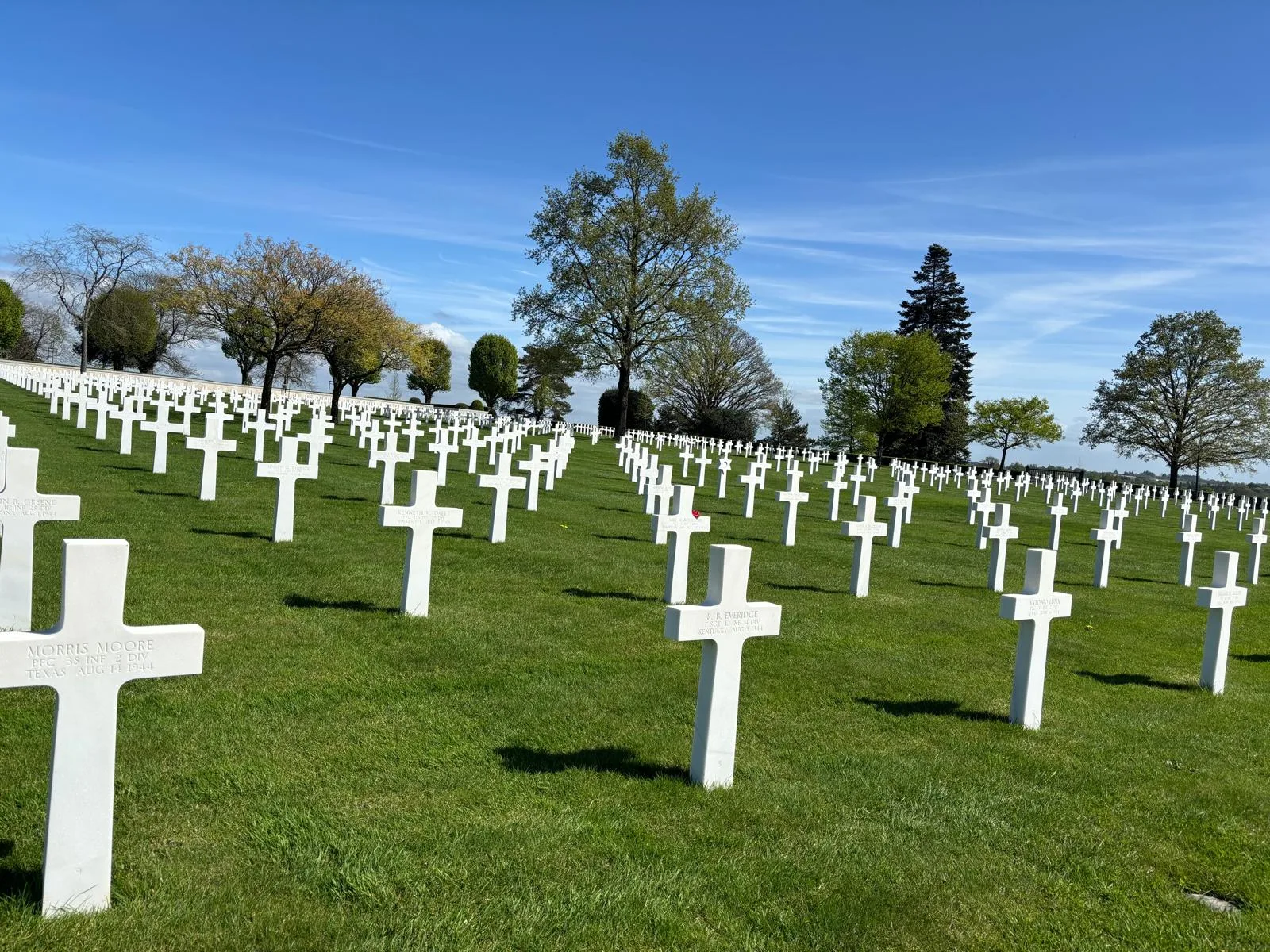 The Brittany American Cemetery at Saint-James, 4,410 graves on a hillside in the Manche
If your route takes you towards Mont-Saint-Michel after the beaches, and for many travellers it does, Saint-James is barely a detour. It is quiet, it is almost empty of visitors, and for families who cannot find their name at Colleville it is very often the place to look next. I have written about two of the men buried there, Abel Marques Jr and the Dombrowski brothers, if you want to understand what that hillside holds.
So How Many Days Do You Need? Three Honest Answers
Here is how I would actually plan it, depending on who you are.
One day works, and works well, if you accept a single sector. Take the American sector: Omaha, the American Cemetery, Pointe du Hoc, then one of Utah or Sainte-Mère-Église, plus at most one small museum. This is the right choice if Normandy is one stop in a broader French trip, and it is complete in itself. I have written the full version of that day here: A Private D-Day Beaches Tour from Paris.
Two days is what I recommend to anyone with a genuine interest in the history, and it is the sweet spot. Day one for the American sector at an unhurried pace. Day two for Arromanches, Juno, Pegasus Bridge and either the Mémorial de Caen or La Cambe. Sleep in Bayeux between the two, which puts you on the sand at first light before a single coach has arrived.
Three days is for family research, for veterans’ descendants, and for anyone who wants the whole arc rather than the highlights. Add the Mémorial de Caen properly, add the German and Commonwealth cemeteries, add time to find a specific grave, and add the drive west to Saint-James and on towards Mont-Saint-Michel or Brittany. This is the version where the story stops being a set of famous names and becomes a campaign you can follow across a landscape.
There is no right answer among these three. There is only the one that matches what you came for, which is why it is worth deciding before you book rather than after you arrive.
Getting Here from Paris: Train or Private Transfer
Whichever length you choose, the approach from Paris is the same decision.
The train is usually the smarter and cheaper option, and travelling by train in France is genuinely pleasant. From Paris Saint-Lazare you reach Caen in about two hours, and Bayeux in about two hours fifteen with a connection at Caen. Bayeux is the better base for the American sector, Caen the better base if you are starting with the Mémorial or the British beaches. Your driver-guide meets you on the station forecourt and you are on the coast within half an hour.
A day trip from Paris and back by train is entirely feasible, provided you take an early departure and accept one sector rather than four.
The alternative is a private car transfer door to door from your Paris hotel, which costs more and adds road time at both ends, but removes every constraint of timetable and luggage. Families travelling with small children, or anyone continuing on to Brittany or the Loire afterwards rather than returning to Paris, are often better served this way. It is a question of budget and of what the rest of your itinerary looks like, and I am happy to tell you honestly which one suits your case.
Planning Your D-Day Visit with BELLIDAYS
I arrange these days privately, for one to seven people, guided in English, Spanish, Italian or Portuguese, with a licensed driver-guide from your arrival station or your Paris hotel.
What I would ask you to do before writing to me is exactly what this article is for: look at the sectors, look at the museums, look at the cemeteries, and tell me what matters most to you. American sector only, or both sides of the landing. Ground or museums. One day, two, or three. And if you have a name in your family, send it to me in advance, and I will locate the grave before you arrive, at Colleville or at Saint-James.
Tell me that much and I will build the days around it, and tell you plainly if what you want does not fit the time you have.
Contact me to plan your D-Day visit
Frequently Asked Questions
Is one day enough for the D-Day beaches?
One day is enough for one sector, done properly. That usually means Omaha, the Normandy American Cemetery, Pointe du Hoc and one further site. It is not enough for the American and the British sectors together, and it is not enough to add a large museum. Two days is what I recommend to anyone with a real interest in the history.
Should I visit the British and Canadian beaches too?
If you have more than one day, yes. Arromanches and the remains of the artificial harbour, the Juno Beach Centre and Pegasus Bridge tell a different part of the story from the American sector, and the engineering of the Mulberry harbour astonishes almost everyone who sees it. With only one day, choose one sector and give it your full attention.
Is the Mémorial de Caen worth half a day?
Yes, but only if you have the half day to give. It is the finest war museum in France and it needs three hours minimum, realistically more. On a single day trip it costs you the beaches, so I would keep it for a two or three day visit and put it first, because everything you see afterwards means more.
How many museums can I fit in one day?
One large museum, or two small ones. The small museums along the coast, Sainte-Mère-Église, Utah Beach, Overlord, Juno, Pegasus, run one to two hours each and sit on your route. The Mémorial de Caen is in a different category and effectively takes a half day.
Is there really another American cemetery near Mont-Saint-Michel?
Yes. The Brittany American Cemetery at Saint-James, about twenty kilometres south of Avranches, holds 4,410 American servicemen who fell during the Normandy campaign and the liberation of Brittany that followed. Very few American visitors know it exists, and it is barely a detour if you are heading towards Mont-Saint-Michel.
Should I take the train from Paris or arrange a private transfer?
The train is cheaper, faster and pleasant: Paris Saint-Lazare to Bayeux in around two hours fifteen, or to Caen in about two hours, with your driver-guide waiting at the station. A private transfer from your Paris hotel costs more but removes all timetable constraints and makes sense for families with young children or for travellers continuing on to Brittany or the Loire afterwards.
Where should I stay if I take two days?
Bayeux, for the American sector and the Commonwealth cemetery, and because you can be standing on Omaha Beach at first light before the first coach arrives. Caen suits you better if you are starting with the Mémorial or the British beaches.
Article written by Belinda C., licensed private chauffeur-guide and founder of BELLIDAYS Travel Tours. Specialising in private tours across Normandy, Brittany and the Loire Valley for international travellers. bellidays.com