

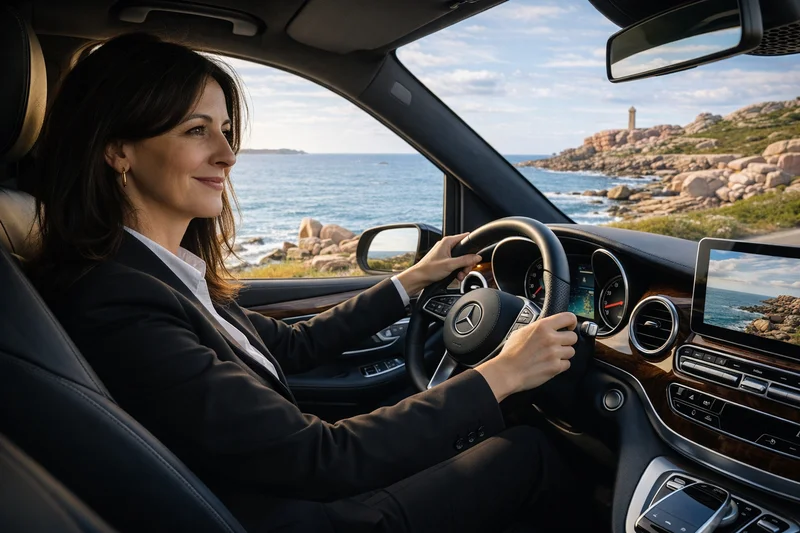
In France, a private driver and a driver-guide are two different professions, and booking the wrong one is the most common disappointment I see. Here is what each one legally does, what it costs, and how to choose.
Last month a guest wrote to me, genuinely upset. She had booked a private driver for a full day in Normandy, a good one, punctual, spotless car, perfect English. And she spent the day asking him questions about the bunkers, the cemeteries, the villages they drove through, and getting almost nothing back. She thought he was being unhelpful. He was being professional. Commentary was not his job, and in certain places it would not even have been legal.
That misunderstanding happens constantly with American and Canadian guests, and it is nobody’s fault. It is easy to assume a driver and a guide are more or less the same thing. In France they are two separate professions, with two separate qualifications, two separate insurance regimes, and two very different prices. If you book the wrong one, you do not get a bad day. You get a day that was never going to be what you pictured.
So here is the whole thing, plainly.
Start with the hyphen
This sounds trivial. It is not, and it is the single most common source of confusion in my inbox.
A driver-guide, with the hyphen, is one person holding two qualifications. They drive you and they guide you.
A driver and guide, no hyphen, is two people. One drives. One guides. Both are with you all day.
A driver is one person who drives.
Three different words, three different products, three different prices. When you write to any operator in France, use the exact term, and if you are not sure which one you are being quoted, ask how many people will be with you that day. It is the fastest way to clear it up.
Option 1: the private driver
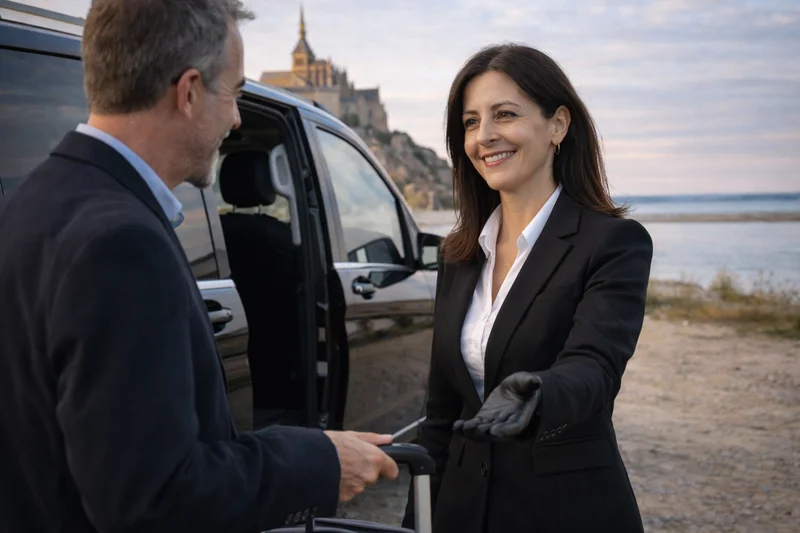
A private driver, called a VTC or a tourism transport operator in France, is licensed to transport you. They hold a professional transport registration, a commercial vehicle, and passenger insurance. That licensing is real and it matters, it is the difference between a legal professional and someone with a nice car.
Here is what a good private driver genuinely does for you, and it is a lot more than steering:
- Plans a realistic route and keeps you on schedule, including tide times on the Normandy and Brittany coasts
- Knows where to park, where the coaches will be, and which entrance to drop you at
- Recommends restaurants and books your table
- Waits for you, carries your bags, adjusts the day if you want to stay longer somewhere
- Handles the logistics you did not even realise were logistics
Here is what they do not do: interpret a monument, tell you the history of a site, or take you through an abbey explaining what you are looking at. Not because they are unwilling. Because they are not qualified for it, and inside certain monuments they are not permitted to do it.
A private driver is the right choice more often than people think. If you have read up beforehand, if you prefer discovering places at your own pace, if you plan to use an audio guide or a site’s own guided tour, a driver gives you total freedom and it is the most affordable of the three formats.
Option 2: the driver-guide
A driver-guide is one person who holds both the transport qualification and the national guide qualification. That second one is what most visitors have never heard of, and it is the part worth understanding.
In France, a guide-conférencier holds a professional card issued by the préfecture, granted on the basis of a recognised diploma, either a licence professionnelle in guiding or a master’s degree containing the required units. It is not a certificate you buy in a weekend.
And it is not decorative. Article L221-1 of the Code du tourisme requires that guided visits inside museums carrying the Musées de France label, and inside classified historic monuments, be led by a guide-conférencier holding that card, whenever the visit is organised or sold by a travel agency or a tour operator. Mont-Saint-Michel abbey, run by the Centre des monuments nationaux, falls squarely inside that rule.
This is why the distinction is not marketing. A driver who improvises commentary inside a protected monument on a commercially sold tour is operating outside the law, and plenty of operators keep that comfortably vague. When you book, you are entitled to ask whether the person guiding you holds the card. A licensed guide will answer immediately and without irritation.
With a driver-guide you get one interlocutor from the first email to the last goodbye, continuous commentary in the vehicle and on site, and legal access to guide you inside the monuments. It is the format most of my guests choose.
Option 3: a driver and a guide, two people
Two professionals, two roles. The driver handles the vehicle, the traffic, the parking and the waiting. The guide stays with you from the first step of the morning to the last, in the car and on foot, and never has to think about anything except you.
It costs more, obviously. Two people means two salaries, and no amount of arranging changes that arithmetic.
The three formats side by side
| Private driver | Driver-guide | Driver and guide | |
|---|---|---|---|
| People with you | 1 | 1 | 2 |
| Commentary in the vehicle | No | Yes | Yes |
| Guided visit inside monuments | No | Yes, licensed | Yes, licensed |
| Tickets and skip-the-line | On request | Usually included | Usually included |
| Waiting while the car is parked | Not applicable | Possible in high season | Never, the guide stays with you |
| Schedule changes on the day | One booking to move | One booking to move | Two schedules to coordinate |
| Relative cost for the same day | Base | Higher | Highest |
| How it is quoted | Per vehicle, not per person | Per vehicle, not per person | Per vehicle plus the guide’s fee |
The part nobody tells you: guiding while driving is hard
I say this as someone who has done it for eighteen years and still finds it demanding.
You are responsible for the lives of the people in your vehicle. You are reading the road, the traffic, the weather, the coach in front of you, and at the same time you are telling a story, answering questions, watching faces in the mirror to see whether anyone has drifted off or wants to stop. Then you park, and you switch instantly into the other job, walking, guiding, projecting your voice against wind coming off the bay, for hours. Then you get back in the car and do the first job again, at the end of a long day.
And then there is parking. In July and August, on the May bank holiday weekends, during French school holidays, the popular sites are saturated. A driver-guide who cannot find a space near the site parks far away, sometimes very far, then walks back to find the group. That walk is not free. It costs the group time, and it costs the guide energy they were going to spend on you.
That is the honest mechanical reason the driver and guide option exists, and the honest reason it costs more. Nobody waits, nobody walks back, and the guide arrives at the abbey with the same energy they had at breakfast.
One warning that applies to all licensed guides
A professional card does not make anyone an expert everywhere in France.
Guides specialise, by region and often by subject. A guide who is genuinely remarkable on the D-Day landings may be ordinary on Loire Renaissance architecture. A guide raised in Brittany will read the bay of Mont-Saint-Michel in a way that no amount of reading can replicate, and may be merely competent in Burgundy.
So when you book, do not just ask whether the person is licensed. Ask which region and which sites they actually work, regularly. If you are covering several regions in one trip, expect, and want, different guides along the way. Anyone who claims equal mastery of the entire country is telling you something about their marketing, not their expertise.
When two people is genuinely the better choice
I am not going to pretend the driver-guide format wins every time. It does not.
Book a driver and a separate guide when you are travelling in peak season at a saturated site, when your group includes someone with limited mobility who should never be left waiting while a car is repositioned, when your day covers a long distance and you want commentary to continue during transfers without tiring the person at the wheel, or when the site calls for a specialist whose knowledge is deeper than any generalist can offer, a WWII historian, a wine specialist, a local expert on a particular monument.
For a full day at one major site with a small group, a driver-guide is usually the better value and the more personal experience. For a demanding itinerary, a large group, or August at Mont-Saint-Michel, two people is worth every euro.
What about tipping?
Tipping is never obligatory in France, service is included, and no one will be offended if you do not. If you want to mark a good day, something in the range of 5 to 10 percent is generous.
The one thing worth knowing in advance: with the two-person format, they are two separate professionals. If you tip, tip each of them, rather than handing one envelope to the driver and assuming it will be shared.
Quick answers
Do private drivers in France give guided tours? No. A private driver transports you, advises you and handles logistics. Commentary inside protected monuments on a commercially sold tour legally requires a guide-conférencier card.
What exactly is a driver-guide? One person holding both qualifications: a professional transport licence and the national guide-conférencier card. They drive you and guide you.
Do I need a licensed guide at Mont-Saint-Michel? For a guided visit inside the abbey as part of a tour sold to you, yes, it must be led by a card-holding guide. You can also visit independently with the abbey’s own audio guide.
Is a driver-guide cheaper than a driver plus a guide? Yes, meaningfully. One person means one fee. Two professionals means two.
How to use this before you book
Decide what you want the day to feel like, then pick the format, then compare prices. Doing it in the other order is how people end up with a driver and a head full of unanswered questions.
If you would like to see the three formats applied to one concrete day, with what is included in each, my Mont-Saint-Michel private tour from Saint-Malo lays out all three side by side.
And if you are still unsure which one suits your trip, write to me and describe your group and your plans. I will tell you honestly which format fits, even when the honest answer is the cheaper one.